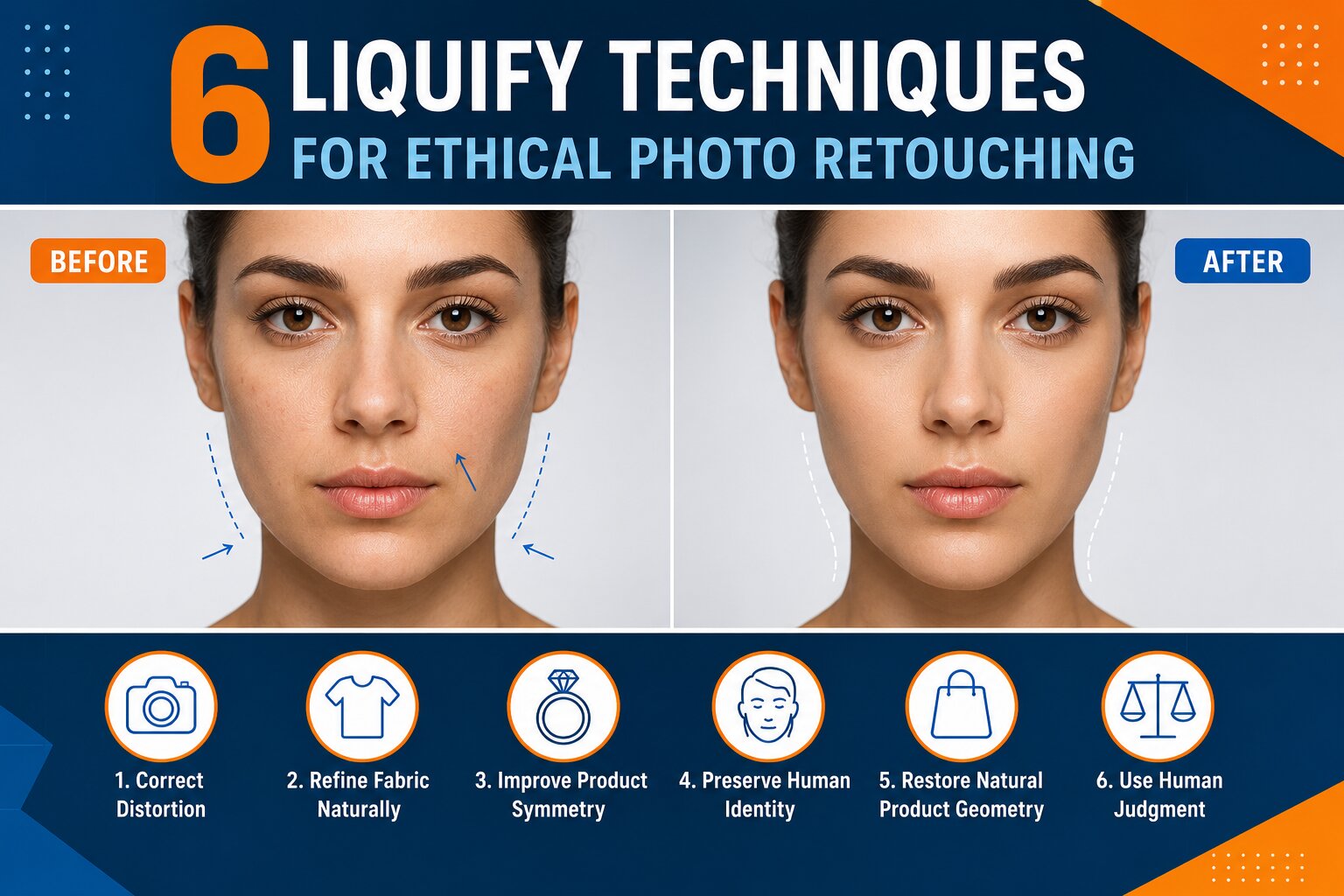
6 Liquify Techniques for Ethical Photo Retouching
Ansu Man | July 22, 2026 | Categories: Retouching | 0 comments
The liquify tool is one of the most precise retouching techniques available for refining the shape of people, products, and objects. When used responsibly, it corrects distortions introduced by lenses, camera angles, garments, or handling during a photoshoot. When overused, however, it can create misleading images that no longer represent the actual subject.
The growing availability of AI-powered image editing has made shape manipulation easier than ever. Automated tools can alter body proportions, reshape products, or modify facial structures in seconds with little human intervention. While this improves speed, it often lacks contextual judgment and can produce unrealistic or deceptive results. Manual liquify work remains valuable because experienced retouchers evaluate every adjustment against the original subject, ensuring that edits remain technically accurate and ethically appropriate.
For brands in fashion, jewelry, E-commerce, furniture, automotive, and other industries, ethical retouching is not only a creative decision but also a trust-building practice. Customers expect product images to accurately represent what they purchase.
1. Correct Camera Distortion Instead of Changing Reality
Wide-angle lenses, perspective distortion, and subject positioning can unintentionally stretch or compress shapes. A manually applied liquify adjustment restores natural proportions rather than inventing new ones.
For example:
- Fashion retailers can restore the natural fall of garments distorted by camera perspective.
- Furniture brands can straighten soft upholstery edges that appear warped because of lens distortion.
- Automotive sellers can correct minor panel curvature caused by ultra-wide photography.
The objective is to match the photographed subject with its real-world appearance rather than enhance it beyond reality.
2. Refine Wrinkles and Fabric Tension Without Altering Garment Fit
Clothing often develops temporary folds while being worn during a photoshoot. Skilled liquify work smooths distracting fabric tension while preserving the garment's true dimensions.
This differs significantly from AI-generated reshaping, which may automatically reduce waistlines, widen shoulders, or create unrealistic garment silhouettes without considering how fabrics naturally behave.
Manual retouchers evaluate seam lines, stitching direction, fabric weight, and garment construction before making localized adjustments, resulting in images that remain faithful to the original product.
3. Improve Product Symmetry Without Misrepresenting Manufacturing
Many handcrafted products naturally contain slight asymmetry. Ethical liquify editing removes visual distractions caused during photography while maintaining the product's authentic design.
Examples include:
- Jewelry where gemstones appear slightly misaligned because of camera angle.
- Leather bags that show temporary deformation from storage or handling.
- Ceramic tableware photographed with slight perspective distortion.
The goal is not to redesign the product but to present it accurately under normal viewing conditions.
4. Preserve Human Identity During Portrait Retouching
Portrait photography presents one of the greatest ethical challenges. Excessive facial reshaping can alter identity and create unrealistic beauty standards.
Responsible liquify work focuses on temporary conditions rather than permanent characteristics. Examples include correcting expressions affected by camera timing, reducing minor clothing pressure on the skin, or restoring facial symmetry influenced by camera perspective.
Manual editing allows each adjustment to be evaluated individually. AI-based tools often apply generalized facial transformations that may unintentionally change bone structure, eye size, jawline, or facial proportions.
This distinction is particularly important for fashion campaigns, corporate portraits, editorial photography, and professional headshots.
5. Restore Natural Product Geometry for E-commerce
E-commerce photography frequently requires shape refinement because products shift during handling, packaging, or styling.
Common examples include:
- Shoes with collapsed toe boxes after transportation.
- Bags with uneven side panels.
- Soft furnishings compressed during storage.
- Packaging slightly deformed during product setup.
Manual liquify adjustments restore the intended geometry without exaggerating size, volume, or product features. This produces cleaner catalog images while maintaining customer expectations.
6. Use Human Judgment Where AI Cannot Evaluate Ethics
The primary difference between manual liquify editing and AI-generated reshaping is decision-making.
An experienced retoucher evaluates:
- whether the modification corrects a photographic artifact,
- whether the adjustment changes the actual subject,
- whether the edit could influence purchasing decisions, and
- whether the final image still represents reality.
AI algorithms primarily optimize visual appearance based on learned patterns. They cannot reliably distinguish between correcting distortion and creating a misleading representation. As a result, automated edits may introduce unrealistic body proportions, product dimensions, or facial characteristics that reduce image authenticity.
Manual liquify work requires careful observation, multiple localized adjustments, and continuous comparison with the original image. This deliberate process produces consistent results while respecting ethical boundaries.
Ethical Retouching Builds Long-Term Customer Trust
The liquify tool is neither inherently good nor bad. Its value depends entirely on how it is used. Ethical retouching corrects distortions introduced during photography, improves visual clarity, and presents subjects as they genuinely appear. It avoids altering defining characteristics that could mislead customers or create unrealistic expectations.
Across fashion, jewelry, e-commerce, furniture, automotive, cosmetics, and consumer products, manual liquify editing continues to deliver a level of precision and accountability that automated AI tools cannot consistently replicate. Skilled retouchers combine technical expertise with human judgment to ensure every adjustment serves image accuracy rather than artificial enhancement.
If your business requires high-quality image refinement that preserves authenticity while enhancing presentation, professional manual photo retouching ensures every liquify adjustment remains technically precise, visually consistent, and ethically responsible.