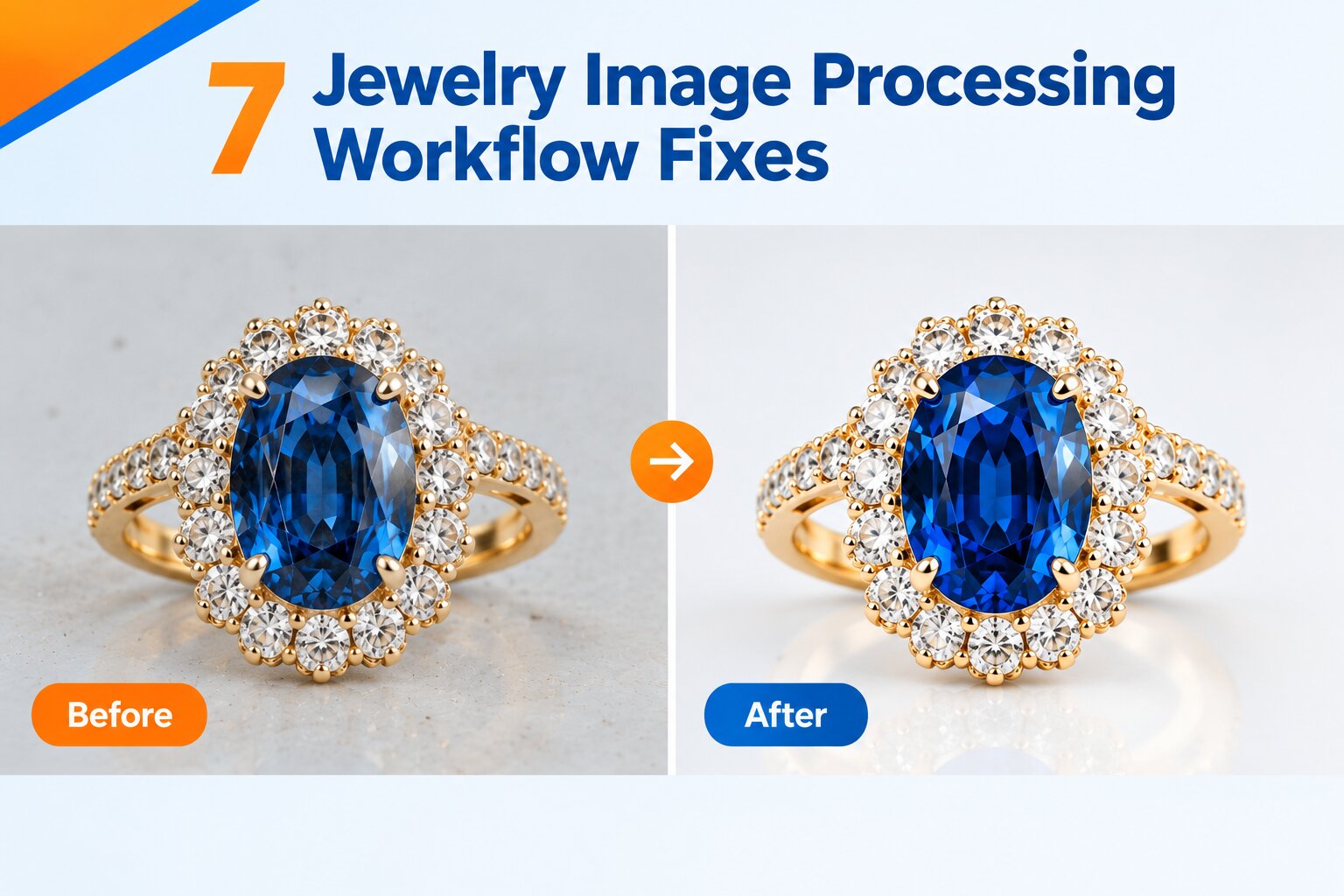
7 Jewelry Image Processing Workflow Fixes
Ansu Man | Oct. 7, 2026 | Categories: Retouching | 0 comments
Editing jewelry images is more complex than many other products for several reasons. In a single shot there can be polished metal, clear gemstones, intricate prongs and chains, engraved details and all types of reflections. Also, dust, fingerprints, edge defects, focus shifts and color casts are easily noticed when viewing at macro magnifications. Jewelry also typically features images with shallow depth of field, so focus stacking becomes important if the entire item must be in focus.
Jewelry retailers and e-commerce brands face a unique challenge. The issue isn’t how to make an image look pretty. The processing workflow must enhance presentation without altering how the product actually looks. The solution must therefore differentiate untreated product from manual retouching, AI-driven processing, and a managed blend of both.
1. Identify What Processing Is Missing in the Raw Image
Jewelry photographs can come with dust particles, fingerprints, uneven illumination, stray reflections, backgrounds, and small surface scratches. These issues may not be noticeable when looking at the camera’s preview screen, but become apparent when showcasing the product large or at high resolution.
The first step of cleaning up jewelry photos is separating technical flaws from actual product details. Small scratches acquired during handling should be cleaned up in post-processing, while actual engraving, stone inclusions, prongs, or textural elements should remain untouched. Jewelry editors don’t want their cleanup work to alter the product.
2. Correct Metal Reflections Without Flattening the Surface
Smooth gold, silver, platinum and other shiny metals will pick up their environment. Photographic reflections can cause strange bright spots, dark areas, color casts, or distracting patches on the jewelry. Soft, controlled lighting can minimize these issues at capture time, but sometimes post-processing is needed as well.
These types of corrections should never remove all highlight information. While manual retouching can reduce or clean unwanted reflections, good jewelry post-processing maintains the illusion of 3D form. Removing too many specular highlights can make metal looks flat and fake.
3. Keep the Gemstone Facets When Sharpening Details
Local processing is required for gemstones because the appearance of the gemstone is determined by the structure of the facets, transparency, internal contrast and controlled highlights. Too much sharpening or brightness can break the tonal separation between facets and make a stone look artificially bright.
Focus stacking of several focus planes taken can give more sharpness front-to-back. However, stacking can create alignment issues, halos, or blending artifacts around prongs, stone edges and reflective surfaces. These areas usually require manual checking after automated or semi-automated merging.
4. Manual Retouching When Judgment at Pixel Level Counts
Manual retouching is still useful for complex jewelry, because the editor can differentiate the product geometry from visual noise.
Fine chains, open settings, prongs, filigree, textured metal and transparent stones may feature boundaries that are difficult to segment correctly by means of automated segmentation.A manual workflow can help refine masks around individual components, remove isolated dust particles, correct localized color contamination, reconstruct clean reflection transitions and preserve extremely thin details. The disadvantage is the processing time and the need for skilled quality control when large catalogs have thousands of images.
5. Use AI to Automate Repetitive Processing Tasks
AI based processing works well when the operation has recognizable patterns. Automation can be employed for background subtraction, object detection, initial masking, dust detection, cropping, exposure correction, white balance correction and image quality screening.
Jewelry though makes for tricky edge cases. Automated segmentation can miss thin portions of a chain, connect close together components, damage transparent regions, or create halos around reflective edges. Another drawback of AI enhancement is that it can misinterpret texture or attempt to resynthesize details that are not present in the source image.
For this reason, AI output should be treated as a processing stage rather than an automatic approval stage.
6. Adding Human Review as a Quality Gate Step
Instead of the above-mentioned process, a more sophisticated approach involves automatic detection and correction of routine problems and then human review of high-risk areas. The person is able to look at gemstone borders, prong integrity, chain, metal color, reflection, shadows, sharpness and background separation.
The color accuracy is especially important. The jewelry should be matched with some reference when it is possible, mostly for yellow gold, rose gold, white metals and gemstones with some coloring. It is important to have controlled light and white balance to set a base and make sure that global correction will not affect the whole image.
7. Construct a Holistic AI Plus Manual Process
This new methodology is not about choosing either manual retouching or AI. It is about the controlled process flow when each technique performs its work best.
A realistic workflow in jewelry can start with an inspection of the source image and its technical quality checks, then move on to AI segmentation, background creation, color correction, cropping, and defect detection. Then the image gets sent to the manual part of the process to handle complex edges, reflections, gemstones, metal details, artifacts of the focus stack and color correction based on individual products.
This way of structuring the process shifts the AI from being a chaotic replacement for retouching to a processing assistant in a quality-controlled process. AI performs repeated tasks at scale, and expert retouchers take decisions where the material behavior and product-specificity is important.
Create a Robust Image Workflow for Jewelry
The best image-processing workflow for jewelry brands is the one which enhances the image quality while maintaining the accuracy of the product. Non-retouched images expose technical imperfections, the completely manual process gives precision but demands lots of editing work, and full automation may have difficulties with the complex geometry and reflection of the jewelry pieces.
The more realistic solution would be the holistic AI-plus-manual approach. You just need to send us a set of your jewelry samples to our professional photo editor, and we will evaluate which parts of the process should be automated, and which parts should be done manually.