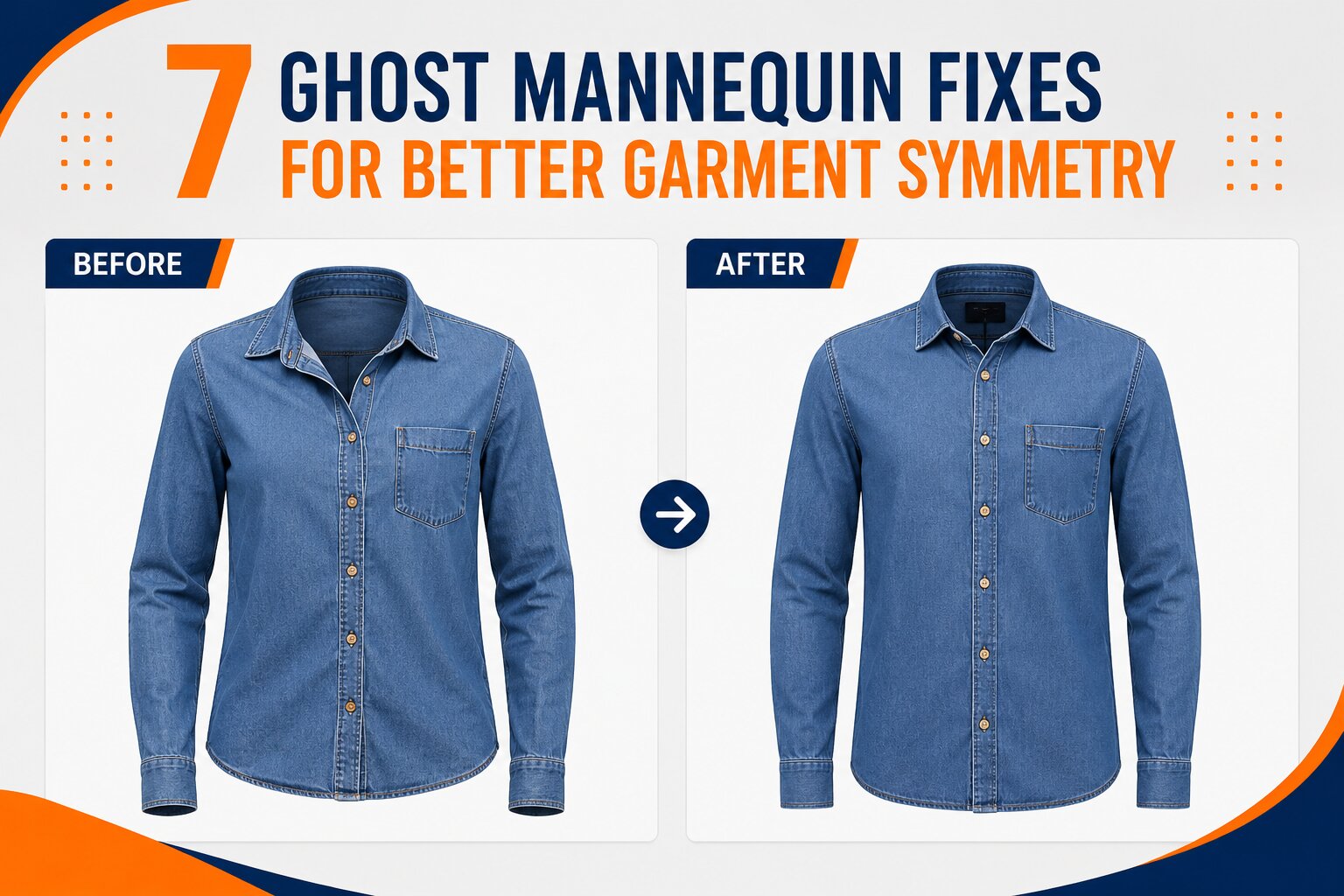
7 Ghost Mannequin Fixes for Better Garment Symmetry
Ansu Man | Sept. 2, 2026 | Categories: Retouching | 0 comments
Ghost mannequin photography creates the appearance of a garment being worn without showing the mannequin, allowing shoppers to examine its shape, construction, and fit. However, removing the mannequin is only part of the technical challenge.
The resulting image can contain distorted collars, uneven shoulders, displaced seams, inconsistent sleeve angles, and asymmetrical hems. If these issues are not corrected carefully, the garment may look structurally different from the actual product.
For e-commerce sellers, this creates a specific image-retouching problem: the garment needs to look clean and dimensional while remaining faithful to its physical construction.
Ghost mannequin retouching therefore involves much more than deleting a mannequin or combining front and interior photographs. Precise symmetry correction, contour reconstruction, wrinkle control, and alignment are necessary to create a technically reliable product image.
1. Establish the Garment's True Centerline
Symmetry correction should begin by identifying the garment's actual centerline. Camera position, mannequin posture, and garment placement can cause the visual center to shift even when the physical garment is symmetrical.
Retouchers can use structural references such as the placket, zipper, neckline, center seam, or button column to establish alignment. The left and right sides should then be evaluated against these references rather than simply mirrored.
This is particularly important for shirts, jackets, coats, and dresses where the centerline controls the perceived fit of the entire garment.
2. Reconstruct the Neck Opening After Mannequin Removal
The neck area is one of the most technically demanding parts of a ghost mannequin image. Removing the mannequin can leave an incomplete collar opening or an unnatural interior shape.
A retoucher may combine visible information from an interior or alternate garment photograph with the main image to reconstruct the missing area. The collar's curvature, seam direction, thickness, and shadow transition must remain consistent with the photographed garment.
Simply filling the opening with a symmetrical shape can make the collar appear digitally manufactured rather than physically constructed.
3. Correct Shoulder and Sleeve Imbalance
Small differences in shoulder height can significantly affect how a garment appears on a product page. A mannequin may lean slightly, one sleeve may hang closer to the camera, or the garment may be pulled unevenly during photography.
Manual retouching allows the shoulder line to be adjusted while preserving the original sleeve construction. Retouchers inspect shoulder seams, armholes, cuffs, and sleeve folds before making localized shape corrections.
For long-sleeve shirts and jackets, both sleeve length and angle should be evaluated. The objective is not to make every pixel mathematically symmetrical, but to restore the intended garment geometry.
4. Preserve Seam and Stitching Alignment
Seams provide some of the strongest visual evidence of garment construction. Aggressive shape manipulation can easily bend, stretch, or disconnect these details.
When correcting symmetry, retouchers should treat major seams as structural guides. Side seams, princess seams, waist seams, pocket openings, zippers, and decorative stitching should follow the corrected garment contour.
For example, if the right side of a blazer is shifted inward, moving the outer silhouette without correcting the corresponding seam can produce a visibly inconsistent result.
5. Balance Hemlines Without Making Them Artificially Perfect
Uneven hems are common in ghost mannequin photography because garments rarely hang in exactly the same position on both sides. Perspective can also make one side appear longer than the other.
Manual symmetry correction can restore the intended hem shape while accounting for garment construction. A-line dresses, skirts, shirts, and coats may require different approaches because their lower contours are influenced by fabric weight and design.
The goal should be structural balance rather than creating a perfectly geometric edge. Natural garment behavior should remain visible.
6. Match Inner and Outer Garment Geometry
A convincing ghost mannequin image depends on the relationship between the garment's exterior silhouette and the reconstructed interior. If these two areas do not align, the final image can appear hollow or physically impossible.
Retouchers need to consider garment thickness, lining, collar depth, armhole placement, and the direction of visible fabric folds. The inner section should visually connect with the outer garment rather than appearing as a separate layer.
This is especially important for structured garments such as blazers, coats, padded jackets, and tailored shirts where the interior construction contributes to the perceived shape.
7. Correct Symmetry Without Destroying Natural Fabric Behavior
One of the biggest mistakes in ghost mannequin retouching is treating symmetry as a simple mirror operation. Real garments contain natural differences in folds, tension, drape, and lighting even when their construction is symmetrical.
Manual retouching allows these differences to remain where they support realism while correcting distortions that interfere with product presentation. Retouchers can selectively adjust contours, shadows, folds, and tonal transitions instead of duplicating one side onto the other.
This distinction is especially valuable for knitwear, silk, denim, velvet, and other materials where texture and drape can change significantly across the garment.
Symmetry Should Describe the Garment, Not Redesign It
Effective ghost mannequin retouching is fundamentally an exercise in reconstructing garment geometry. The objective is to remove the mannequin while maintaining believable relationships between collars, shoulders, sleeves, seams, hems, openings, and fabric folds.
For e-commerce sellers, this technical accuracy matters because shoppers use product images to judge proportions, construction, and expected appearance. An incorrectly reconstructed neckline or artificially straightened sleeve can create an inaccurate impression of the actual garment.
Professional manual retouching provides the localized control needed to correct these problems without flattening natural fabric behavior. Instead of applying uniform symmetry or automated shape adjustments, skilled retouchers can evaluate each structural element and preserve the characteristics that make the garment physically believable.
If your apparel images contain uneven shoulders, distorted collars, misaligned seams, incomplete mannequin removal, or inconsistent garment proportions, contact our professional photo retouching team at PicsRetouch for precise ghost mannequin and symmetry correction that preserves the actual construction and appearance of your garments.