6 Healing Brush Fixes That Improve Image Quality
Ansu Man | July 8, 2026 | Categories: Retouching | 0 comments
Modern photo retouching software offers several automated retouching tools, including the Spot Healing Brush and the Healing Brush. At first glance, both tools appear to solve the same problem by removing blemishes, dust, scratches, wrinkles, and other unwanted imperfections. However, they operate very differently, and understanding these differences is essential for businesses that depend on high-quality product images.
Why Healing Brush Still Matters in Professional Retouching
Many clients assume that removing imperfections is a one-click process. In reality, automated tools often struggle with complex textures, repeating patterns, reflective surfaces, and fine details. As image complexity increases, professional retouchers rely more heavily on the manual Healing Brush. Although this produces significantly better results, it also requires additional editing time, making manual retouching more labor-intensive than automated alternatives.
1. Spot Healing Brush Uses Automatic Sampling
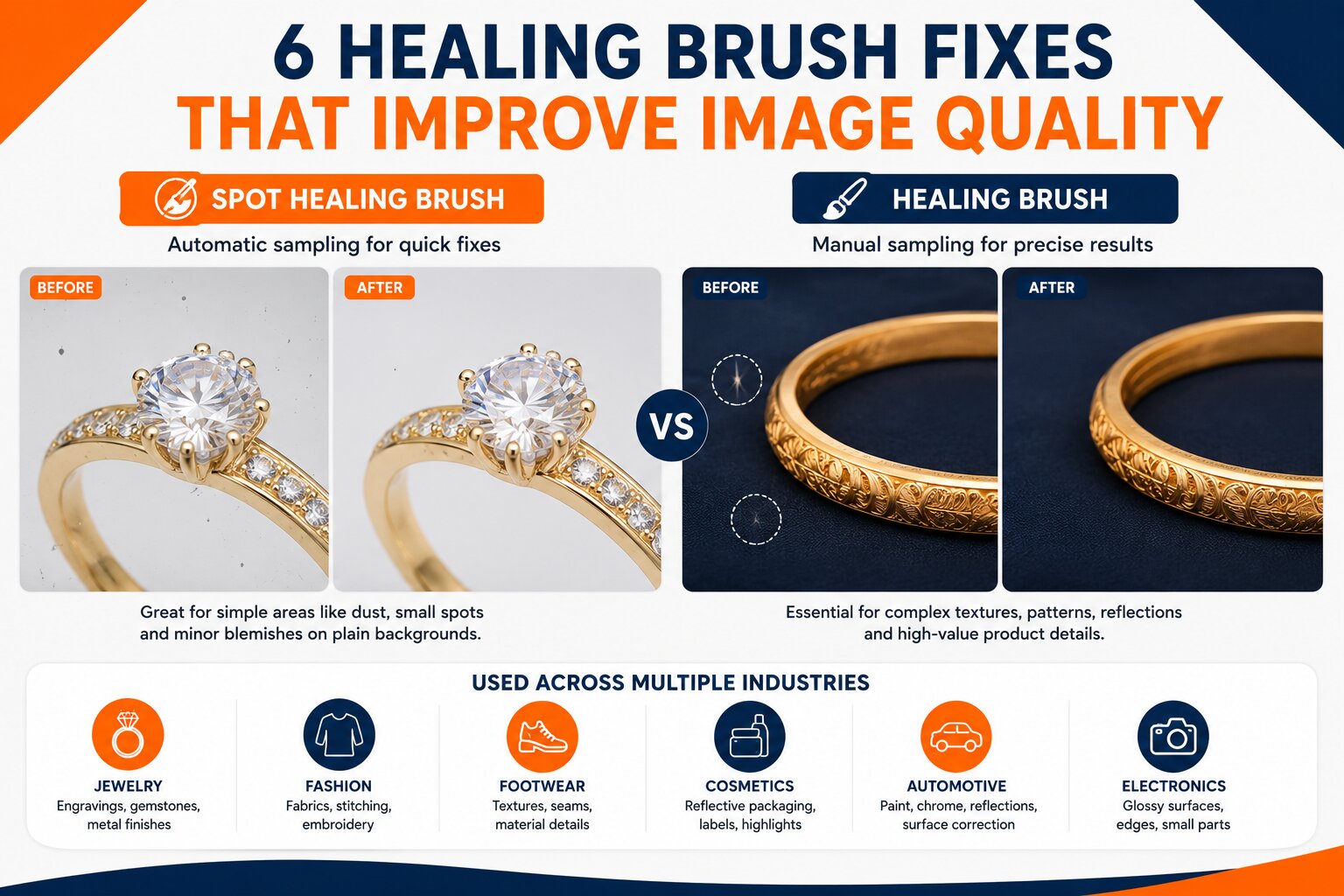
The Spot Healing Brush automatically analyzes the pixels surrounding the area being repaired and generates replacement texture using proprietary software's content-aware algorithms. It is extremely fast for removing isolated dust spots, sensor marks, tiny blemishes, and small imperfections on simple backgrounds.
However, because the sampling is automatic, the tool has no understanding of product structure or image context. On textured materials, repeating patterns, engraved surfaces, or product edges, it may generate blurry patches, duplicated textures, or distorted details that reduce image quality.
2. Healing Brush Gives Complete Control
Unlike the Spot Healing Brush, the Healing Brush requires the retoucher to manually choose the source area by sampling pixels from an appropriate location. The software then blends texture, color, and luminosity while preserving the surrounding image characteristics.
This manual workflow gives experienced retouchers precise control over where replacement texture originates. As a result, complex surfaces retain their natural appearance without introducing obvious editing artifacts. The trade-off is that every correction requires careful judgment, making the process considerably slower than automatic healing.
3. Product Photography Often Requires Manual Healing
E-commerce product photography frequently contains imperfections that cannot be corrected using automated tools alone. Leather handbags may have natural grain patterns, jewelry contains intricate engravings, footwear displays textured stitching, and electronic devices include sharp edges with reflective finishes.
When the Spot Healing Brush encounters these details, it often replaces them with incorrect textures. Professional retouchers instead use the Healing Brush to preserve material consistency while removing scratches, dust, fingerprints, and manufacturing marks.
4. Different Industries Present Different Challenges
Every industry introduces unique retouching requirements that influence tool selection. Jewelry images require precise restoration around gemstones, prongs, and engraved metal surfaces. Fashion garments demand careful repair around seams, embroidery, lace, and fabric textures. Cosmetic packaging contains reflective plastics and metallic finishes that require controlled sampling. Automotive photography involves glossy paint, chrome trim, and reflections that automated tools frequently misinterpret.
In each of these situations, the Healing Brush provides significantly greater precision because the retoucher selects exactly which texture should replace the damaged area.
5. Better Quality Comes with Higher Retouching Time
One of the most common misconceptions about photo retouching is that software automation eliminates manual work. While automated tools accelerate basic corrections, premium commercial retouching still depends on skilled manual editing for complex images.
Healing Brush corrections require continuous source selection, texture matching, edge preservation, and quality verification throughout the editing process. Images containing hundreds of small imperfections may require thousands of manual brush applications before achieving a professional finish. This additional effort directly influences retouching time and overall editing cost, but it also produces cleaner, more natural results that automated workflows cannot consistently achieve.
6. Combining Both Tools Produces the Best Results
Professional retouchers rarely rely on a single tool throughout an entire project. Instead, they combine the speed of the Spot Healing Brush with the precision of the Healing Brush. Simple imperfections are removed automatically, while sensitive areas receive manual attention where texture accuracy is critical.
This hybrid workflow improves efficiency without sacrificing image quality. The result is a polished photograph that maintains realistic textures, preserves product integrity, and meets the visual standards expected in professional e-commerce photography.
Professional Retouching Depends More on Manual Tools Than Automation
The Spot Healing Brush is an excellent productivity tool for straightforward corrections, but it cannot replace the experience and decision-making required for high-end commercial retouching. Whenever texture continuity, product detail, or material accuracy is important, manual Healing Brush work becomes essential.
Understanding this difference helps explain why premium retouching services require more time than automated editing. The goal is not simply to remove imperfections, but to do so without compromising the authenticity of the product.
Need Flawless Product Images?
Whether you sell jewelry, fashion, footwear, cosmetics, furniture, automotive products, or consumer electronics, professional manual retouching ensures every image maintains its natural appearance while eliminating distracting imperfections. Our experienced retouchers at PicsRetouch combine advanced techniques with careful manual editing to deliver clean, realistic, and high-converting product images.
Contact us today to learn how professional photo retouching can elevate the quality of your product photography and strengthen your e-commerce brand.