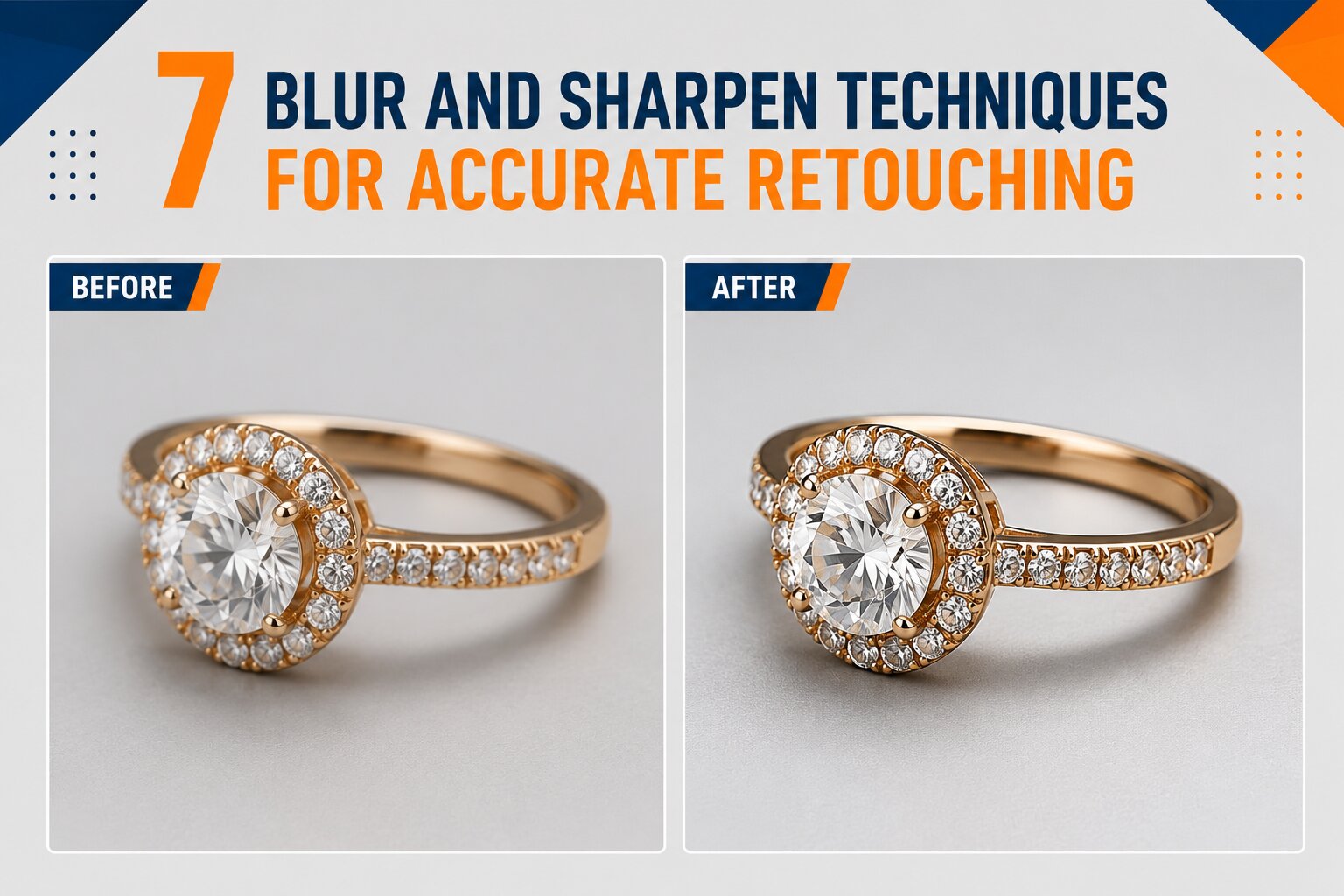
7 Blur and Sharpen Techniques for Accurate Retouching
Ansu Man | Aug. 12, 2026 | Categories: Retouching | 0 comments
Image sharpness plays a critical role in how customers evaluate products, materials, and visual quality. Whether it is a gemstone in a jewelry catalog, stitching on a luxury handbag, fabric texture in fashion photography, or fine details on consumer electronics, clarity directly influences perception.
However, photography conditions often introduce challenges such as slight focus inconsistencies, lens softness, digital noise, and distracting background details.
Many AI-powered image enhancement tools promise instant sharpening and automated detail recovery. While these technologies can improve visual appearance quickly, they frequently apply generalized adjustments across the image.
This often results in artificial textures, halo artifacts, over-sharpened edges, and unrealistic detail generation. Manual blur and sharpen retouching remains essential because experienced retouchers evaluate every adjustment based on actual image data rather than algorithmic assumptions.
For brands operating in e-commerce, fashion, jewelry, automotive, furniture, and consumer goods industries, precise blur and sharpen techniques help improve image quality while preserving authenticity.
1. Selective Sharpening for Product Detail Enhancement
Not every area of an image requires the same level of sharpness. Applying global sharpening across an entire photograph often increases noise and creates distracting artifacts.
Manual retouchers isolate important areas and apply sharpening only where visual clarity is required.
Examples include:
- Gemstone facets in jewelry photography.
- Brand logos on product packaging.
- Watch dials and engravings.
- Stitching details on luxury leather goods.
By targeting specific regions, retouchers enhance detail visibility while maintaining a natural appearance throughout the rest of the image.
2. Controlling Edge Contrast Without Creating Halos
One of the most common problems with automated sharpening systems is halo formation. Bright outlines appear around edges when excessive contrast is added during enhancement.
Manual sharpening techniques allow retouchers to control edge contrast with precision. Instead of amplifying all transitions equally, they evaluate individual structures and adjust sharpening intensity according to subject characteristics.
This approach is particularly important for metallic products, jewelry, automotive surfaces, and electronics where clean edge definition contributes to perceived quality.
3. Using Blur to Eliminate Visual Distractions
Blur is not simply a corrective tool. When applied strategically, it helps direct viewer attention toward the most important areas of an image.
Retouchers often soften distracting elements that compete with the primary subject.
Examples include:
- Background textures in fashion photography.
- Secondary reflections in jewelry images.
- Minor environmental distractions in automotive photography.
- Unimportant packaging elements in product catalogs.
Unlike AI systems that may blur large regions indiscriminately, manual retouching preserves important boundaries and maintains natural depth relationships.
4. Refining Fabric and Material Texture
Fashion brands frequently encounter challenges when photographing textured fabrics. Depending on lighting conditions and camera settings, important material characteristics may appear either too soft or excessively harsh.
Manual sharpening techniques enhance weave patterns, embroidery, stitching, and surface texture without exaggerating imperfections.
For premium apparel, maintaining realistic fabric appearance is essential because customers often evaluate quality based on visible texture characteristics. Skilled retouchers adjust sharpening selectively to reveal detail while preserving the natural behavior of the material.
5. Improving Jewelry and Luxury Product Presentation
Jewelry photography requires a balance between sharpness and smooth tonal transitions. Excessive sharpening can introduce noise into polished metal surfaces and create unrealistic gemstone textures.
Manual blur and sharpen workflows allow retouchers to sharpen intricate areas such as prongs, gemstone edges, and engravings while preserving smooth reflections in surrounding metal surfaces.
This localized approach produces a cleaner and more realistic presentation compared to automated enhancement systems that often treat reflective and textured surfaces identically.
6. Enhancing Automotive Surface Definition
Automotive photography presents unique challenges because vehicles contain both highly reflective surfaces and complex body contours. AI-based sharpening frequently amplifies reflections and environmental artifacts along with legitimate detail.
Manual retouchers selectively sharpen panel edges, wheel details, lighting components, and design features while controlling unwanted reflections.
The result is improved visual clarity that accurately represents vehicle construction without introducing artificial surface textures.
7. Preserving Authentic Detail Beyond AI Generation
The most significant difference between manual blur and sharpen retouching and AI-generated enhancement lies in how image information is interpreted.
AI systems often estimate missing detail based on learned patterns. In some cases, this process can generate textures that were never present in the original photograph. While visually appealing, these generated details may misrepresent the actual product.
Manual retouching relies entirely on existing image data. Retouchers evaluate texture, edge structure, noise characteristics, and subject material before making adjustments. Every sharpening decision is based on real photographic information rather than synthetic reconstruction.
This distinction is especially important for e-commerce product photography where image accuracy influences customer expectations and purchasing confidence.
Why Manual Blur and Sharpen Retouching Still Delivers Superior Results
Blur and sharpen techniques are far more sophisticated than simply increasing or reducing image clarity. Professional retouchers use these tools to control focus hierarchy, enhance texture visibility, manage distractions, and improve visual communication while preserving image authenticity.
Although AI-powered enhancement tools continue to evolve, they often lack the contextual understanding required to distinguish between meaningful detail and unwanted artifacts. Manual retouching provides precise control over every adjustment, ensuring that image improvements remain realistic and technically accurate.
Across jewelry, fashion, automotive, furniture, cosmetics, consumer electronics, and e-commerce photography, skilled blur and sharpen retouching helps create images that are visually refined while remaining faithful to the original subject.
If your product images require enhanced detail, improved texture definition, and precise focus control without artificial-looking AI artifacts, contact PicsRetouch retouching team to discover how advanced manual blur and sharpen techniques can elevate your visual content.