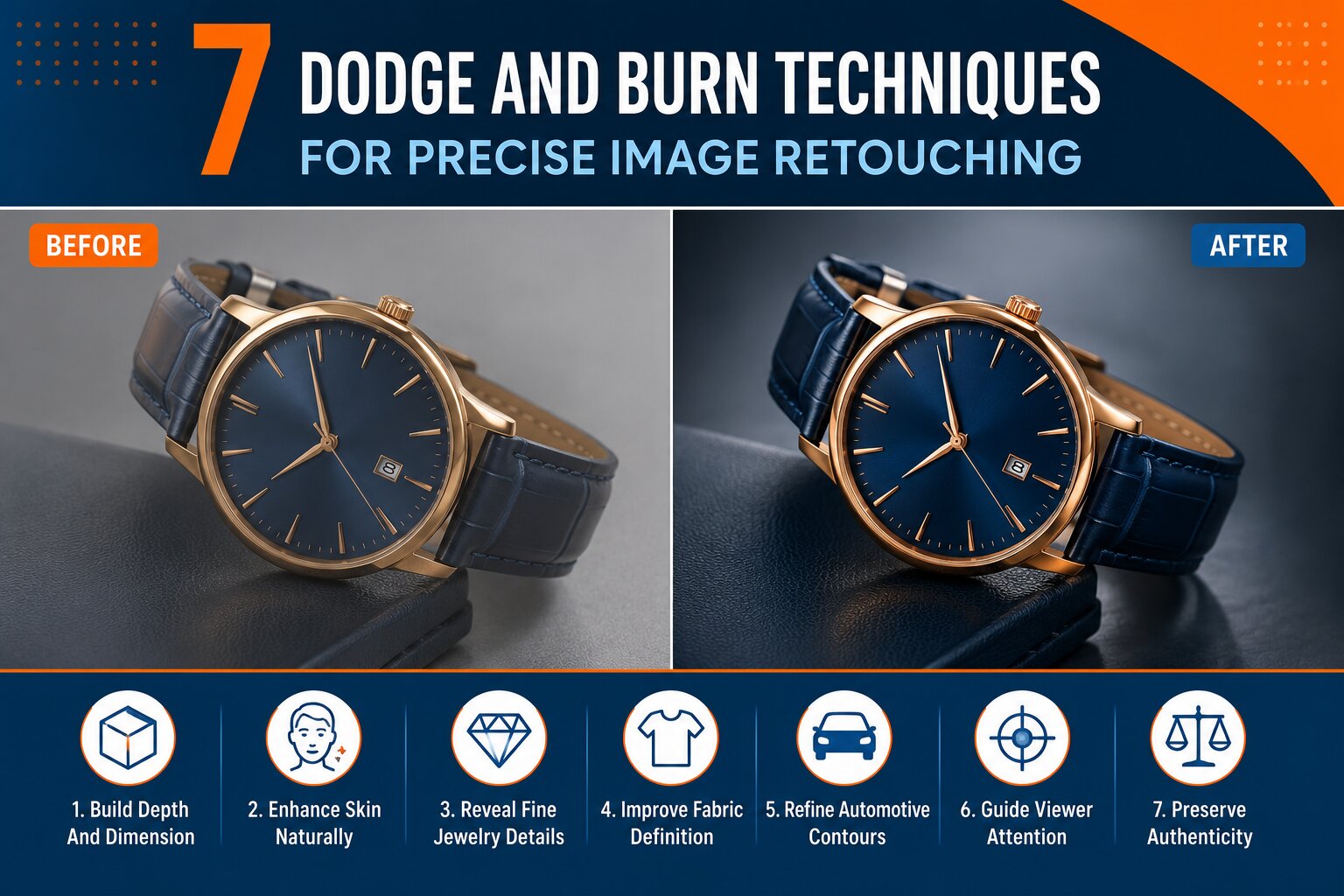
7 Dodge and Burn Techniques for Precise Image Retouching
Ansu Man | July 29, 2026 | Categories: Retouching | 0 comments
One of the most common challenges in commercial photography is uneven light distribution. Products may appear flat, skin textures can lose definition, jewelry surfaces may lack depth, and fabric details can become less visible under studio lighting.
While modern AI tools can automatically enhance contrast and brightness, they often apply broad adjustments that affect entire regions without understanding the underlying structure of the image.
Dodge and burn retouching remains one of the most effective manual techniques for controlling tonal transitions with precision. By selectively brightening (dodging) and darkening (burning) specific areas, PicsRetouch can enhance dimension, reveal texture, and guide viewer attention while preserving the authenticity of the original photograph.
Unlike AI-generated edits that rely on pattern recognition, manual dodge and burn work is performed pixel by pixel, allowing precise control over every tonal adjustment.
1. Building Depth Through Controlled Light Shaping
Many product photographs suffer from flat lighting, particularly when soft light sources are used to minimize harsh shadows. While this approach reduces unwanted reflections, it can also remove visual depth.
Manual dodge and burn techniques restore three-dimensional appearance by carefully enhancing highlight and shadow transitions. Retouchers analyze surface contours and apply localized adjustments to strengthen natural light flow across the subject.
For example, luxury handbags often require selective shadow enhancement around stitching, folds, and edge construction to emphasize craftsmanship without altering the actual product shape.
2. Enhancing Skin Texture Without Smoothing It Away
In beauty and fashion photography, excessive automated retouching frequently removes important skin characteristics. AI tools often interpret natural skin texture as imperfections and generate overly smooth surfaces.
Professional dodge and burn retouching takes a different approach. Instead of removing texture, retouchers selectively reduce tonal inconsistencies while preserving pores, fine details, and natural skin variation.
This process can require hundreds of localized adjustments across a single portrait. The result is cleaner skin that still looks realistic under close inspection.
3. Revealing Fine Jewelry Details
Jewelry photography presents unique tonal challenges because reflective metals and gemstones often contain extreme brightness variations. Automated enhancement tools frequently over-brighten highlights, causing detail loss in polished surfaces.
Manual dodge and burn work allows retouchers to control light distribution within metal edges, gemstone facets, prongs, and engravings.
For example, a diamond ring may contain dozens of small reflections that require individual refinement. By selectively brightening certain facets and darkening others, retouchers can improve brilliance while maintaining realistic optical behavior.
4. Improving Fabric Definition in Fashion Photography
Fashion brands rely on accurate representation of fabric texture, weave patterns, embroidery, and garment construction. Flat lighting can reduce visibility of these important details.
Dodge and burn retouching enhances tonal separation within folds, seams, pleats, and stitching lines. Rather than artificially increasing overall contrast, retouchers work on specific areas where additional depth is needed.
This technique is particularly valuable for premium fabrics such as silk, velvet, denim, and textured knitwear where surface detail influences purchasing decisions.
5. Refining Automotive Surface Contours
Automotive photography often involves large reflective surfaces that capture environmental light inconsistently. AI enhancement tools may create uneven reflections or unrealistic highlights across body panels.
Manual dodge and burn adjustments help define curves, edges, and panel transitions while maintaining accurate reflections.
For vehicle resellers and automotive brands, this approach improves visual clarity without altering the actual design of the vehicle. Surface contours become more visible while preserving authenticity.
6. Directing Viewer Attention Through Tonal Control
Effective commercial photography guides the viewer toward key elements within an image. Automated editing systems typically lack the contextual understanding required to prioritize visual hierarchy.
Dodge and burn techniques allow retouchers to subtly increase emphasis on important features while reducing distractions.
Examples include:
- Drawing attention toward gemstones in jewelry photography.
- Enhancing branding elements on product packaging.
- Emphasizing facial features in corporate portraits.
- Highlighting craftsmanship details in luxury goods.
These adjustments are often imperceptible individually but collectively improve image engagement and readability.
7. Preserving Authenticity Beyond AI Automation
The most significant difference between manual dodge and burn retouching and AI-generated enhancement lies in decision-making.
AI systems evaluate images using learned visual patterns and statistical models. While they can improve images quickly, they often apply uniform corrections that fail to account for material properties, lighting behavior, and subject-specific characteristics.
Manual retouchers evaluate every tonal transition based on the physical structure of the subject. They determine where highlights should naturally occur, how shadows should fall, and which areas require adjustment.
A single high-end product image may require thousands of localized dodge and burn strokes. This level of precision allows subtle refinements that maintain realism while enhancing visual quality.
Whether working on fashion apparel, jewelry, cosmetics, furniture, consumer electronics, automotive photography, or luxury products, manual dodge and burn retouching delivers a level of control that automated tools cannot consistently replicate.
Why Skilled Dodge and Burn Retouching Still Matters
Dodge and burn remains one of the most technically demanding retouching techniques because it focuses on tonal refinement rather than broad visual manipulation. Every adjustment is based on careful observation of light behavior, texture structure, and surface characteristics.
While AI tools can generate rapid enhancements, they often lack the precision required for commercial photography where image accuracy directly affects customer perception. Manual dodge and burn retouching provides controlled, realistic improvements that preserve texture, depth, and product authenticity.
If your brand requires product, fashion, jewelry, beauty, automotive, or commercial images that maintain realistic detail while achieving a polished professional appearance, expert photo retouching services can apply advanced dodge and burn techniques to maximize image quality without compromising authenticity.
Contact our professional photo retouching team today to discover how precision dodge and burn retouching can enhance texture, depth, and visual impact across your commercial image library.