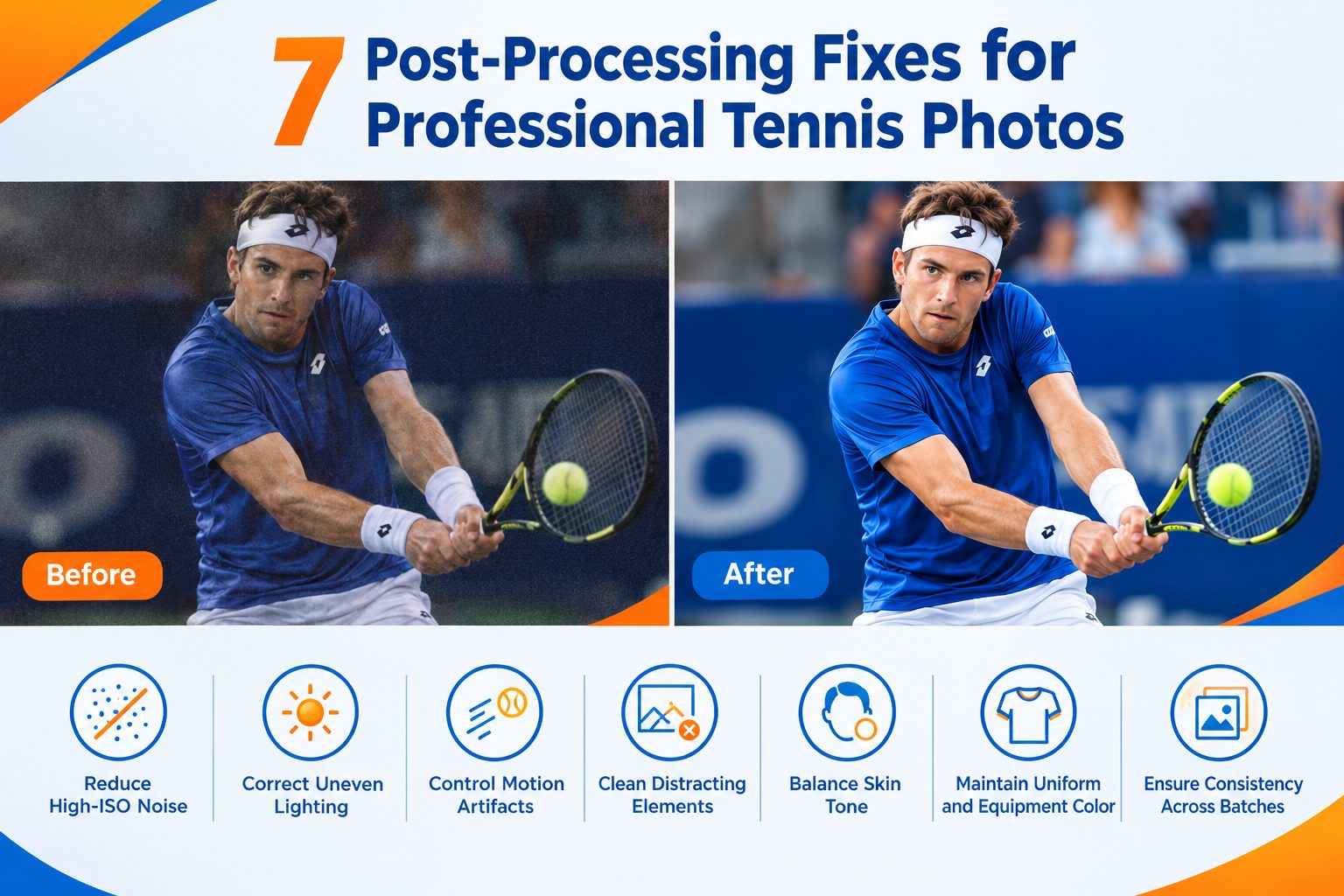
7 Post-Processing Fixes for Professional Tennis Photos
Ansu Man | Sept. 23, 2026 | Categories: Retouching | 0 comments
Photographers who operate within the sphere of sports photography face virtually no problems with frame undercapture. However, what happens after the competition becomes rather troublesome because of the huge number of pictures, which varies from hundreds to thousands and features a variety of issues related to the exposure, motion blur, noise, background distraction, uneven skin tones, and other minor imperfections.
It is particularly relevant in the case of ATP tournaments, at which photographers need to take shots of everything, from the game itself to the player portraits, training, arrivals, victory celebrations, etc. Although a quick shot with the use of a fast camera and a long lens allows capturing the decisive moment, the file that comes out of this process needs some post-processing work.
The goal is not making all the shots look artificial. Instead, it is necessary to restore useful information and remove any distractions while keeping the player recognizable.
1. Minimizing ISO Noise Without Loss of Skin and Fabric Detail
When playing indoors, during nighttime games, or even during the dark areas of outdoor courts, photographers tend to use high ISO to maintain high-speed shutter settings, making noise removal a laborious task.
The global approach to noise removal often does not work well since significant loss of luminosity could result in the loss of detail like eyelashes, facial features, tennis string detail, shoelaces, and jersey fabric. Retouching requires a new workflow by distinguishing between smooth tones and high frequency content. It would allow for the aggressive removal of noise in background areas while maintaining the texture near the athlete's face, clothing, and ball.
2. Improving Consistent Light in Stadia and Court Settings
Many tennis courts have a number of distinct lighting areas. As the player progresses from the baseline to the net, he/she may move between areas with different levels of exposure, color temperatures, and shadows.
Local exposure control can help improve this situation without making the entire scene uniform. It is also important to be careful when setting the white balance since colored courts, advertisements, artificial lights, and architecture in proximity can affect the skin and clothing color.
3. Motion Artifacts on the Racket and the Ball
The body, the racket, the strings, and the ball of a tennis player can have very varying speeds in a single shot. Therefore, applying equal sharpening to the whole picture might lead to halos on the player, but will not improve the motion-blurred areas.
Different sharpening needs to be applied to the different objects. Facial features including the face and the eyes can require different sharpening from the racket frame, the strings, shoes, or the ball. Sharpening should add to the existing detail, and not create new information where there was none before.
4. Reduction of Court and Stadium Distractions
In professional tennis photography, there are certain distracting background elements that cannot be avoided while capturing action shots; loose gear, unattended seats, wires, small bits of litter, signboards with holes in them, photographer’s position, and audience near the player are some of the distractions.
These distractions can only be minimized through masking and cloning of images, not by replacing the background. The court lines, net structure, geometry of the stadium, and overall background perspective have to retain their believability.
5. Skin Color Balance with Mixed Lightings
A significant change can occur in skin color when influenced by stadium lightings, colors of the reflected court, and varying amounts of illumination. The effect of global color correction on one individual can be great, but unnatural for others.
Retouching requires separating skin from uniforms and background colors before the adjustment of tones. The goal is to ensure that the skin looks natural, along with its texture and highlight marks caused by sweat, while eliminating unwanted colorations. This factor becomes especially important for close-ups of faces, celebration shots, and editorials where the face of the player makes up most of the picture.
6. Proper Depiction of Colors of Uniform and Equipment
In many cases, pictures taken at sports events involve the proper depiction of jerseys, shoes, tennis rackets, bracelets, etc. Images that are too saturated or contrast can distort the perception of the color of such items.
This means that during the process of color correction, one needs to be able to distinguish between grading and actual color preservation. With selective adjustment, it will be possible to restore colors that have been distorted because of improper exposure while preserving the original color of athlete’s uniform and equipment.
7. Consistency in a Large Number of Photographs of a Tournament
The main obstacle to overcome during the post-production process comes from the fact that there can be inconsistencies between various usable pictures. These variations might come from different contrast values, white balance values, and the amount of noise reduction performed on various images.
Creating a retouching strategy will set up some standard values for exposure, contrast, color balance, noise, sharpening, skin retouching, and background clean-up. All these standard values will need to be changed on a picture-by-picture basis based on the lighting conditions or specific characteristics of each photo.
This process is especially useful for professional photographers who are shooting ATP tournaments because one job can provide them with a great number of action shots along with many additional photos.
Conversion of Difficult Frames into Uniform Sports Photography
Sports photography post-production is not limited to the simple adjustment of sharpness or contrast. The essence of the task lies in the ability to separate motion from detail, noise from texture, unusual lighting effects from actual colors, and the removal of distractions within the environment of sports.
The solution for ATP tournaments and professional tennis photography requires a unique retouching process that will help cope with the correction of difficult images while maintaining the truthfulness of the photograph. This will allow the photographer to focus on choosing a good frame, without spending much time on the same adjustments within a large number of photographs.
In case the photography of tennis or sports results in high ISO photographs, uneven lighting in the stadium, distractions in the background, motion-related effects, or a large amount of photos requiring the same corrections, we will be able to analyze your problematic elements and create a consistent retouching process for you.