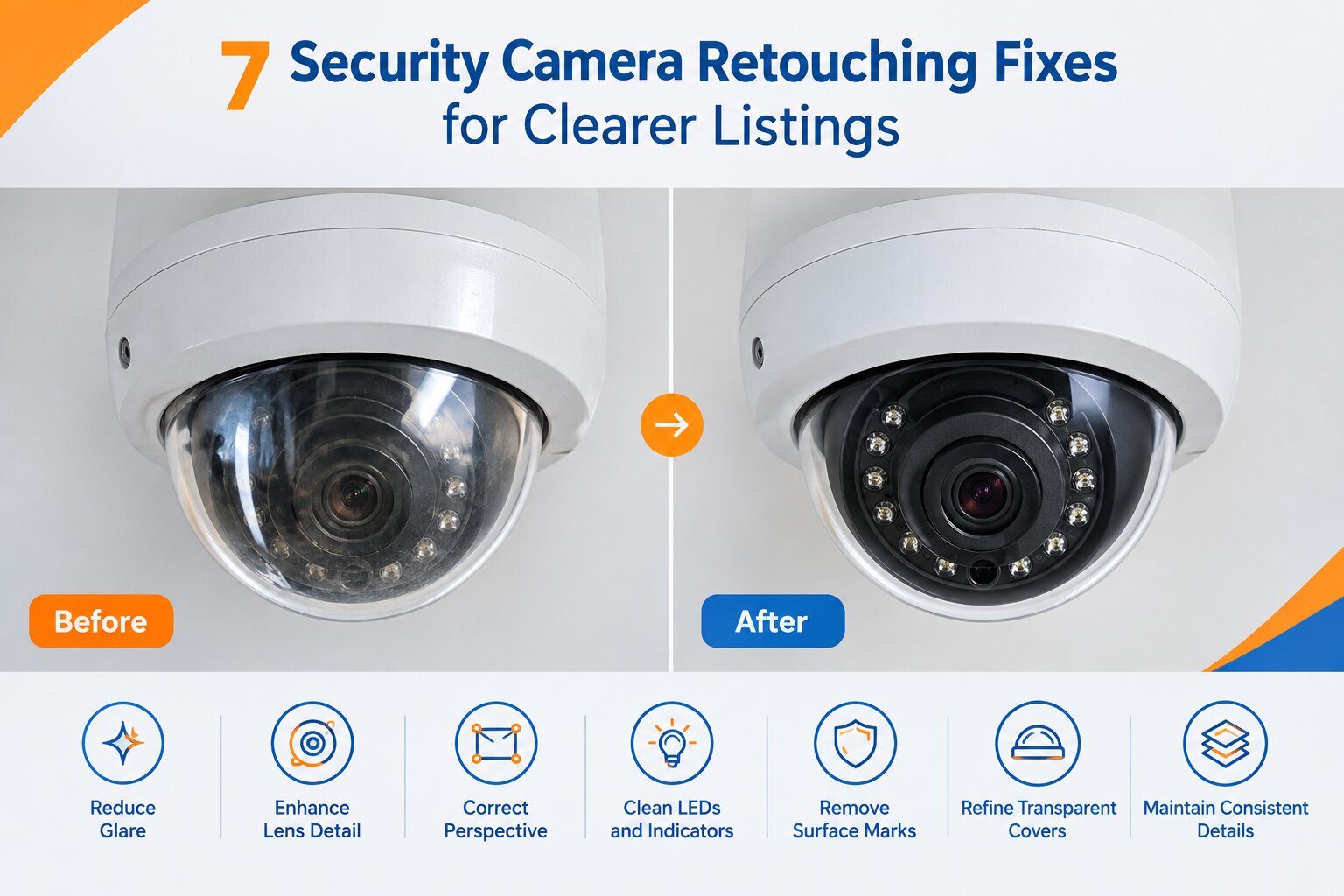
7 Retouching Fixes for Security Cameras Listing Photography
Ansu Man | Sept. 9, 2026 | Categories: Retouching | 0 comments
Technical products such as security cameras and alarm devices usually have catalog photographs that resemble any other non-technical product. This is a particular issue for sellers since buyers need to see tiny hardware details, but they are frequently obscured by reflections, glare, distortion, overexposure, dust, and inconsistent backgrounds.
In case of security equipment, retouching should aim to preserve the technical accuracy of the image rather than beautify the product. A retouched image of the product should show its housing, lens assembly, ports, buttons, mounting points, LEDs, cable connection points, surface finish, and so on.
1. Manage Glare Without Removing Highlights from the Housing
Glossy plastic, painted metal, or other coatings on security camera housings result in strong specular highlights. Such highlights frequently obscure the borders between camera body and its parts.
To retouch such an image, the excess highlights need to be reduced, but the real highlights need to be preserved. Localized tonal adjustments can restore detail in the overexposed areas, while selective increase of contrast near the edges preserves the 3D form of the housing. Completely removing all the reflections can flatten the housing and alter the material appearance.
2. Reveal Details Around the Camera Lens
In a security camera, the lens area will often have the strongest visual appeal. The finest details of the reflective areas around the lens barrel, protective glass, infrared emitters, and bezel will sometimes be hard to reveal under non-controlled illumination conditions.
Technical retouching procedures need to isolate the lens area from the rest of the camera and make local adjustments to exposure and contrast. Dust spots, fingerprints, and other accidental blemishes from the protective glass should be cleaned up, but the optics themselves should be left untouched. Excessive sharpening of the lens may create halos at its edges.
3. Fix Barrel Distortion and Perspective Distortion
Product photography using wide-angle cameras can result in some significant geometric distortion, such as curve appearance of straight lines and elliptical shapes of circles due to the camera angle of dome cameras and small surveillance devices.
Perspective correction needs to be done in a very precise way to maintain the right proportions of the object. The purpose of perspective correction is not to redesign the device, but to help buyers perceive it correctly. This step is important when customers compare several products by their dimensions, mounting options, and housing shape.
4. Fix Infrared LED and Status LED Problems
Color contamination and blown highlights may appear when taking photos of infrared LEDs and status LEDs, depending on the sensor sensitivity and surrounding reflections. These indicators may seem larger or brighter than they really are due to sensor clipping.
Photographic retouching can help you clean up color spilling from the LEDs and fix the tonal range of the area surrounding them while maintaining their position and shape. It's not recommended to change the color of an intentionally illuminated indicator in order to have it similar to other photographs of the same product.
5. Remove Manufacturing and Handling Marks
Minor scratches, fingerprints, dust specks, glue marks, and other handling imperfections can stand out vividly on dark security equipment. Nevertheless, not all surface irregularities need to be removed.
Product retouching must be able to tell apart temporary photography flaws and permanent product features. Removable fingerprints can be cleaned up, whereas real texture, ventilation opening, seam, screw head, or molded feature must stay there. The difference is critical since over-retouching may eliminate valuable information buyers use to assess the device.
6. Improve Dome Cover and Protection Hinges
Dome cameras complicate the process of retouching because their transparent domes reflect the surroundings and show the interior of the product. Removing all the reflections can deprive the image of visual proof that the product is protected by a dome cover.
It is better to selectively manage reflections. Disorienting reflections can be toned down, haze can be cleaned up, dust can be removed while preserving enough natural reflections to indicate the presence of transparent material. Interior elements should retain their alignment with the original photograph instead of being edited too aggressively.
7. Standardize Product Specifications in Photos
Listings of security devices tend to include multiple images of the item shown from various angles: front, back, side, underside and mounted positions. Poorly done retouching between these images makes the catalog look technically inaccurate.
The exposure, neutral background tone, shadow opacity, sharpness of edges, and color balancing need to be consistent in the whole set of pictures. At the same time, individual details of physical appearance have to be true for each particular camera angle. The picture set becomes visually coherent but not artificial copies of each other.
Making Security Equipment Easy to Examine
Successful retouching of security alarm or camera pictures is not so much about the enhancement of appearance as control of visual information. Reduction of glare, correction of optical area, perspective adjustment, selective sharpening, surface cleaning, and proper tonal treatment make technical product photography inspection much easier.
The primary necessity for the seller is that retouched security equipment product pictures should provide better visibility without distortion of geometrical properties, material, indicators, ports, lenses, and other technical features of the product.
In case the security camera or alarm product images have reflections, flaws on the lens, perspective issues, unbalanced backgrounds, or confusing hardware specifications, photo editing services will fix these problems without affecting the technical look of the product. Submit your product images to the retouchers to determine the best way to fix them.